 Skip to content
Cable Burial Risk Assessment
Burial feasibility, anchor risk and protection recommendations for subsea cable routes.
QOffshore delivers Cable Burial Risk Assessments (CBRA) and Burial Assessment Studies (BAS) for projects across Australia and APAC. We combine seabed survey interpretation, geotechnical evidence and marine activity analysis to establish where a cable can be buried, the protection it needs, and the risks that remain.
Connect the required protection with achievable burial
A burial depth is useful only when it answers two questions: will it protect the cable from the assessed threats, and can it be achieved in the ground conditions along the route? Soft clay, shallow rock, mobile sandwaves and busy vessel corridors can require very different responses within the same project.
QOffshore brings the BAS and CBRA together so the recommended protection can be compared with practical installation options. The result supports route refinement, survey planning, burial specifications and discussions with cable installers.
How DTS, BAS and CBRA fit together
A Desktop Study (DTS) screens route and landfall constraints and defines investigation priorities. A BAS interprets the seabed and assesses trenchability, likely achievable burial and suitable tools. A CBRA evaluates external threats and the protection required. Combining them exposes sections where the required depth exceeds likely burial capability.
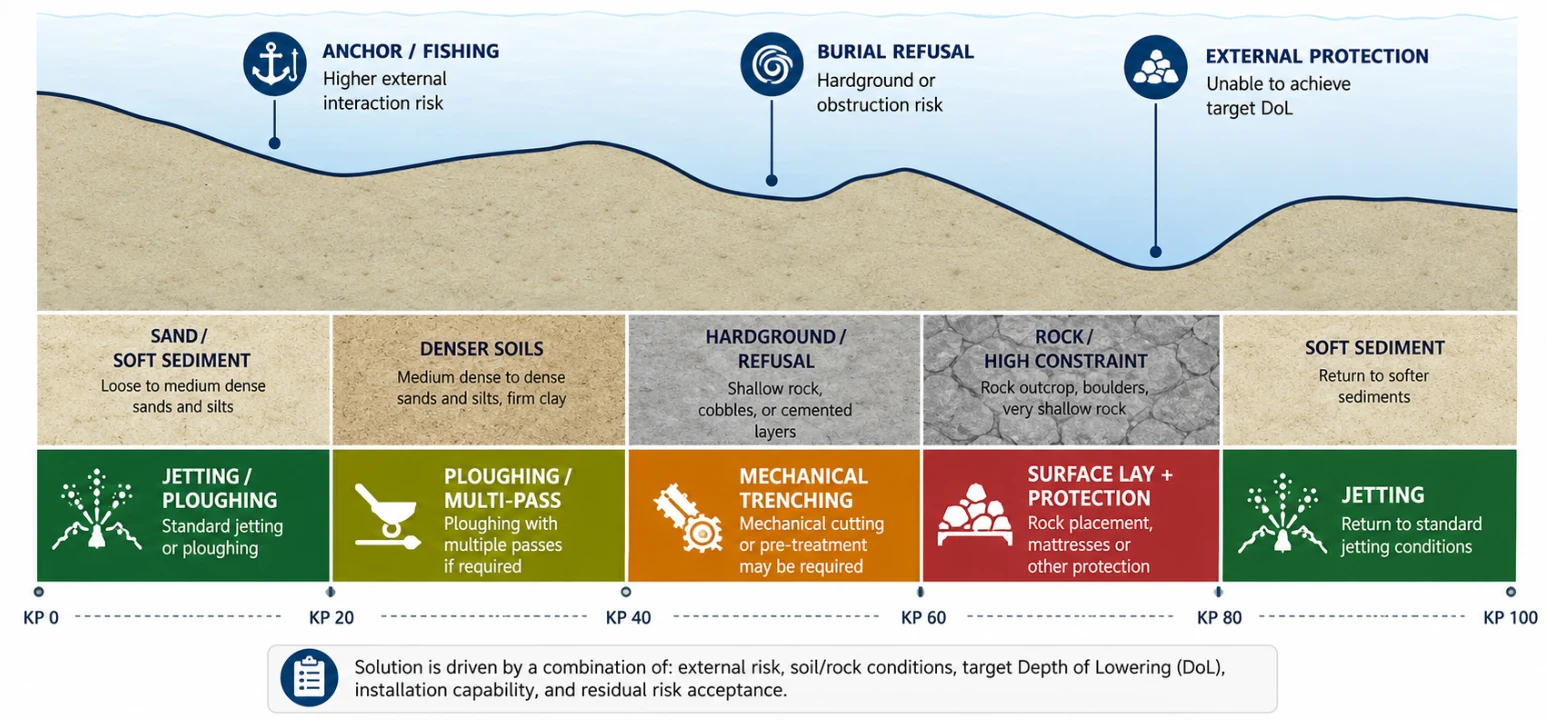
Illustrative burial-method selection: sediment and rock conditions influence the installation options. The KP ranges are examples, not project results. Actual methods depend on ground conditions, external threats, equipment capability and the agreed protection requirement. Select the image to enlarge.
The threats and constraints we assess
Shipping and anchor interaction
Automatic Identification System (AIS) vessel tracks, crossing frequency, vessel size, speed and water depth inform the anchor threat assessment. We examine anchoring or waiting activity separately from through-traffic and document the assumptions used to estimate anchor size, penetration and strike probability.
Fishing and mooring interaction
We review seabed-contact fishing gear, local fishing activity and Fish Aggregating Device (FAD) moorings where relevant. AIS alone may miss small vessels and unrecorded activity, so evidence gaps and the need for fisheries information remain explicit.
Mobile seabeds and loss of protection
Sandwaves, megaripples, scour and changing seabed levels can reduce protection or create exposed spans. We assess available evidence for seabed mobility and identify where repeat surveys or a dedicated study are needed to support a burial allowance.
Hardground, slopes and burial refusal
Cone Penetration Test (CPT) results, core recovery, sediment thickness and geophysical interpretation help identify soft sediments, dense layers, shallow rock and abrupt transitions. These conditions are assessed against tool capability, route gradients and the required depth.
Crossings, obstructions and other activities
Existing cables and pipelines, debris, boulders, dredging and geohazards can require micro-routing, crossing design, clearance or specialist investigation. The assessment identifies where burial alone cannot provide a suitable response.
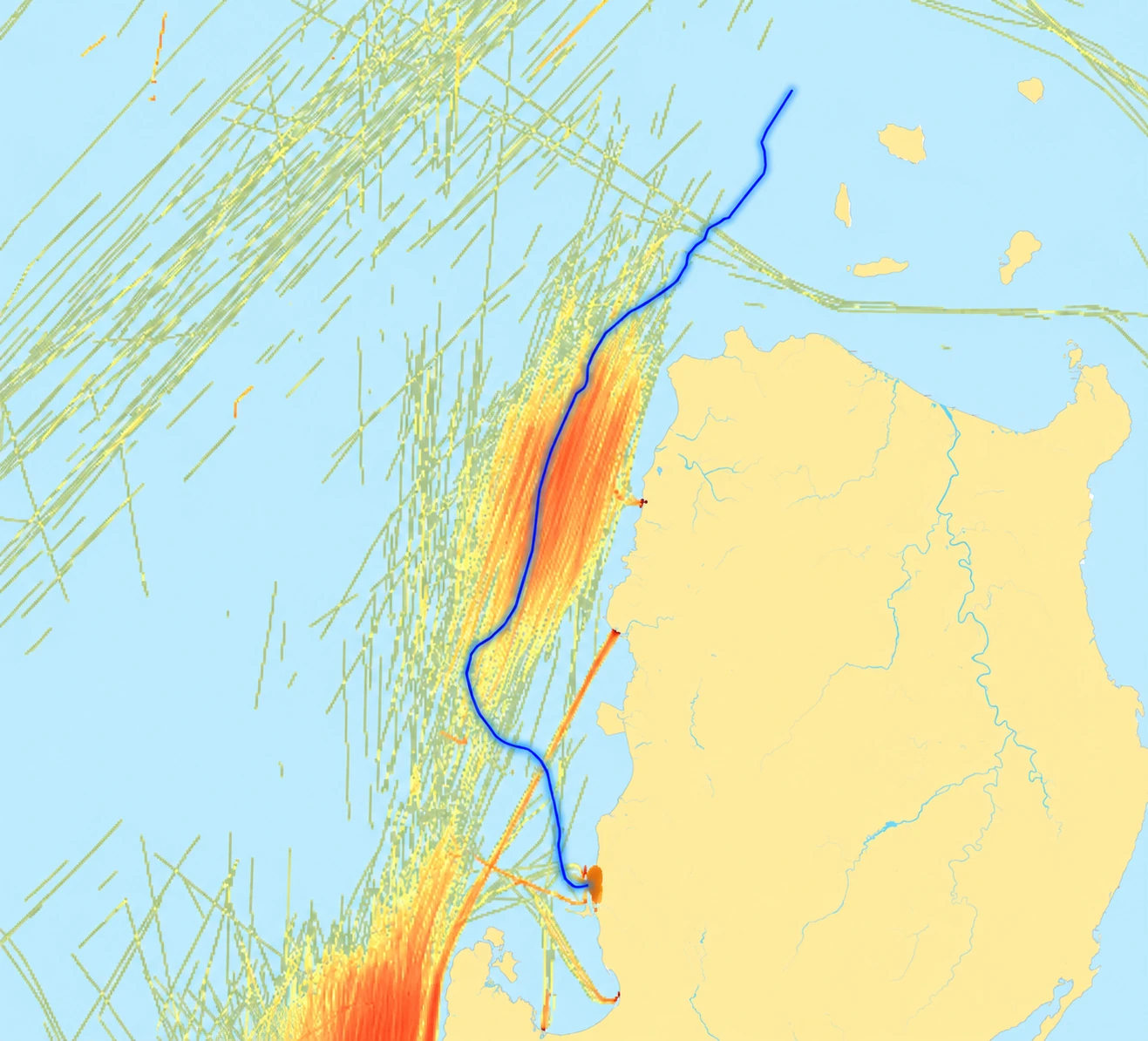
Vessel density and route exposure. Concentrated shipping activity can identify sections needing closer assessment of vessel and anchor interaction. This presentation adaptation has identifying labels removed and is not a navigational or calculation output. Select the image to enlarge.
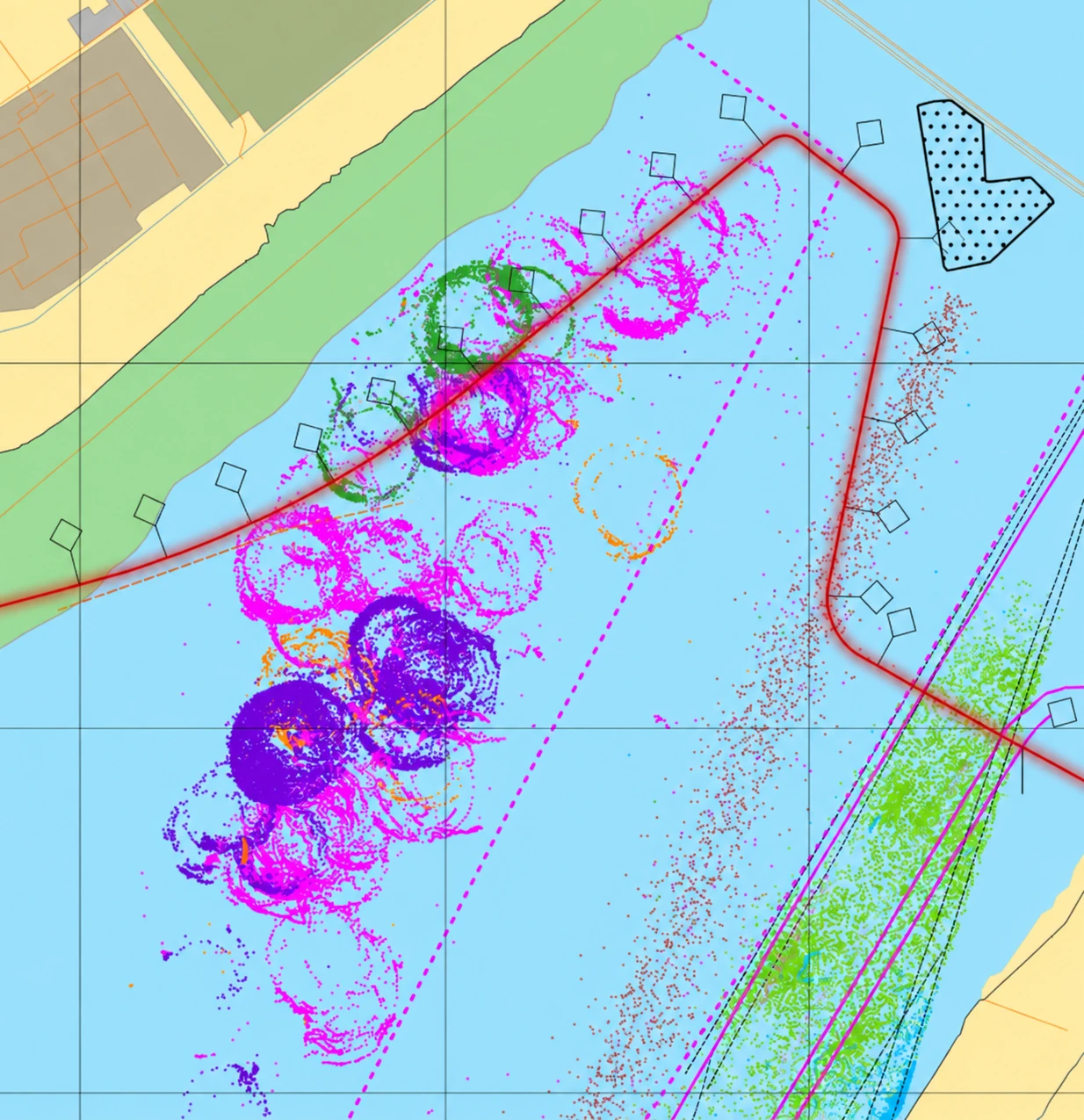
Vessel activity near a proposed cable route. Position clusters help focus the review, but must be interpreted with vessel type, speed and navigation status; clusters alone do not prove anchoring or cable risk. Presentation adaptation with identifying labels removed. Select the image to enlarge.
A traceable approach to burial and residual risk
Our assessment approach draws on the Carbon Trust Cable Burial Risk Assessment guidance (CTC835, 2015), alongside project-specific evidence and engineering judgement. The guidance was developed for offshore wind cables; its application to a project must reflect the cable system, local conditions and agreed scope.
1. Establish the route and evidence base
Review the route position list, cable characteristics, project stage and available surveys. Check data coverage, resolution, age and suitability, including whether geotechnical tests reach the depth relevant to burial.
2. Segment the route and assess feasibility
Correlate the ground model with bathymetry and seabed features. Identify changes in sediment, rock, slopes and crossings, then evaluate burial methods such as jetting, ploughing and mechanical cutting.
3. Evaluate threats and compare depth scenarios
Develop the risk register and assess the relevant anchor and fishing threats. Where the data support it, use probabilistic anchor-strike analysis to compare depth scenarios and inform the residual-risk discussion.
4. Reconcile protection, installation and remaining risk
Compare the recommended protection with achievable burial and applicable project requirements. Where the target is impractical, assess alternative protection or route changes. Record assumptions, further work and the decisions requiring agreement with the owner and installer.
An anchor-strike probability is not automatically a cable-failure probability. We keep that distinction clear and avoid interpreting a small or rounded model result as proof of zero risk. Acceptable residual risk is agreed for the project; it is not a universal threshold.
Depth of Lowering: specify the right requirement
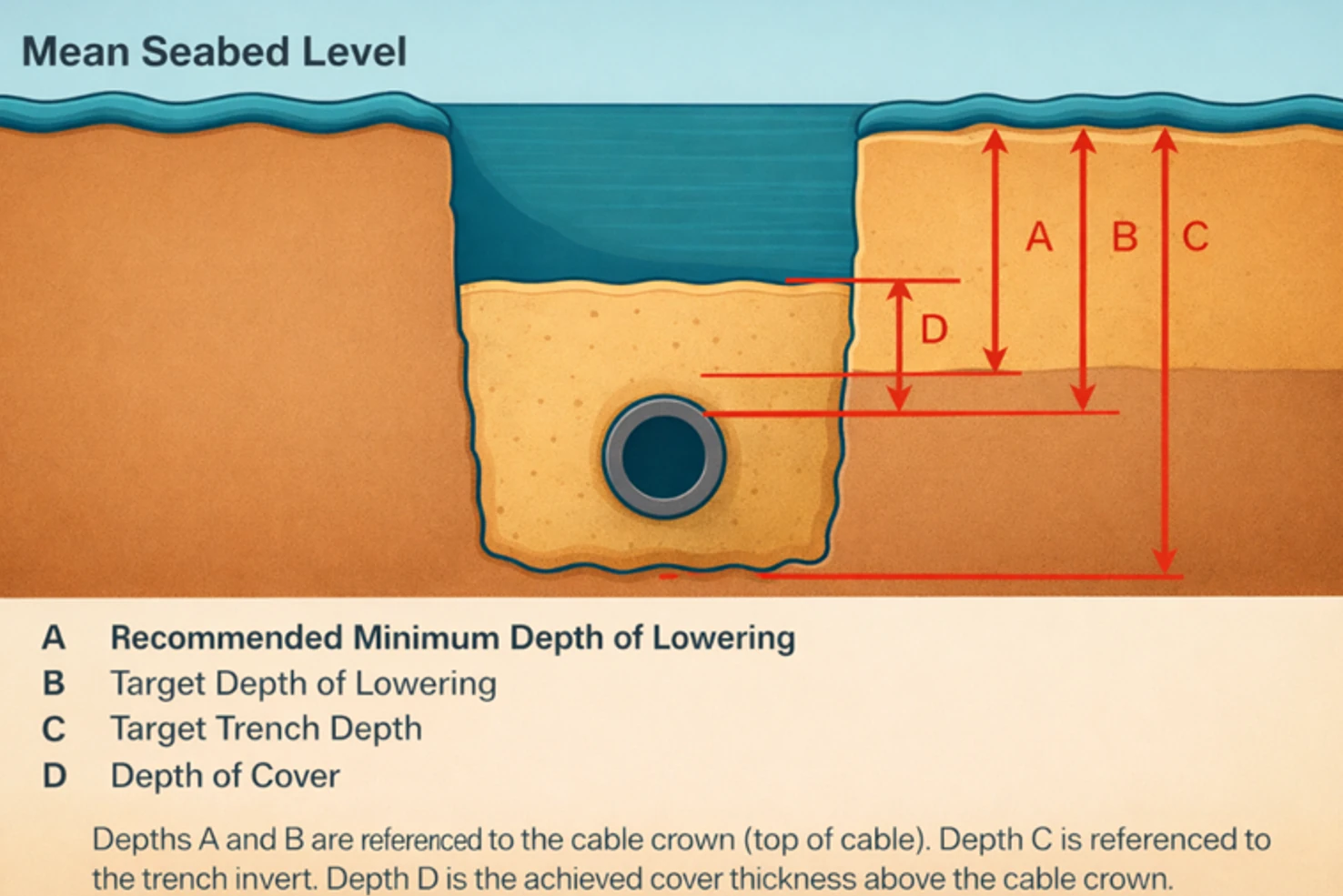
Depth definitions — schematic, not to scale. A and B refer to the cable crown; C to the trench bottom; D to the material covering the cable crown. The seabed reference and allowances for mobility must be defined for each project. Select the image to enlarge.
We distinguish the protection requirement from the installation target and the achieved result. This avoids treating trench depth, cable depth and sediment cover as interchangeable.
Recommended minimum Depth of Lowering
The depth to the top of the cable recommended by the risk assessment, referenced to a defined seabed level. Mobile sediment and anticipated seabed change must be considered when establishing that reference and the required protection.
Target Depth of Lowering
The installation target agreed for the project, at least equal to the recommended minimum and including justified allowances. The BAS tests whether the target is feasible along each route section.
Trench depth and achieved cover
Trench depth is measured to the trench bottom. Depth of cover is the material remaining above the cable after installation. These are distinct from the design DoL and require installation engineering and verification.
What your BAS and CBRA package contains
Route-section burial assessment matrix
A kilometre-point (KP) schedule linking interpreted ground conditions, hazards, target and likely achievable burial, tool suitability and protection recommendations. It gives the engineering and installation teams a common basis for reviewing each section.
Mapped evidence and engineering outputs
Route profiles, burial-feasibility zones, vessel-activity plots and relevant constraint maps. Agreed GIS or CAD outputs link the recommendations back to the route, supporting design review and changes to the alignment.
CBRA report and calculation workbook
The assessment basis, vessel and anchor inputs, depth scenarios, probability results and stated assumptions. Results are presented with their limitations so the project team can review the residual risk and the effect of different protection options.
Risk register and next-phase actions
Hazards, consequences, initial risk, mitigation and residual risk, together with further investigation and verification requirements. The package identifies unresolved items for detailed design, contractor review and post-lay inspection. Deliverable formats and assessment detail are agreed at scoping.
Experience with contrasting cable-route conditions
Our completed submarine cable studies show why protection requirements must be assessed alongside local ground conditions. The examples below show how the assessment changes with the evidence and installation constraints.
A shallow corridor with concentrated vessel activity
We combined geophysical survey interpretation with a year of AIS data to examine vessel interaction, seabed disturbance and changing sediment conditions. The study produced burial recommendations and tool-selection guidance while identifying missing geotechnical evidence, seabed-mobility information and future dredging requirements.
Cable approaches with different traffic and ground conditions
We integrated CPTs and gravity cores with bathymetry, side-scan sonar and sub-bottom profiles. Comparing vessel exposure and anchor penetration across route sections supported burial-depth scenarios, a trenching-tool matrix and a geotechnical risk register. Fishing and FAD information gaps were carried into the recommendations.
Routes constrained by rock and limited sediment thickness
Our assessments identified sections where hardground, shallow refusal and steep slopes limited achievable burial despite a specified target depth. The recommendations differentiated feasible burial from sections needing route adjustment, reduced burial or engineered external protection, with further verification requirements.
Engineering supported by survey expertise
QOffshore combines subsea route engineering with hydrographic, geophysical and geotechnical interpretation. This helps connect the survey evidence to burial decisions and define targeted investigation where the evidence is incomplete.
- Survey expertise led by a CPHS Level 1 certified professional
- ISO 9001 Quality Management
- ISO 14001 Environmental Management
- ISO 45001 Health and Safety Management

Survey and engineering services supporting CBRA
A burial assessment can use existing survey data or help specify the next investigation. QOffshore can support survey planning, technical specifications and client representation to obtain and review the evidence the engineering assessment needs.
Cable burial risk assessment: common questions
What is included in a cable burial risk assessment?
The agreed scope typically includes a data-adequacy review, route segmentation, external-threat assessment, burial-depth recommendations and a residual-risk register. Combined BAS and CBRA work adds trenchability, tool suitability and likely achievable burial. The report, calculation workbook and route outputs document the basis for the recommendations.
How long does a cable burial risk assessment take?
The programme depends on route complexity, the quality and completeness of the inputs, and the required assessment detail. Additional geotechnical investigation, vessel-data acquisition or seabed-mobility work can affect timing. We define the programme after reviewing your available information.
Do you provide CBRA services outside Australia?
Yes. QOffshore supports subsea cable projects across Australia and APAC. The scope is adapted to local seabed conditions, marine activities, installation constraints and project requirements.
Can a study start before all survey data are available?
Yes. An early assessment can screen constraints and prioritise further investigation. Geophysical interpretation alone may not establish soil strength or tool performance, and a single seabed survey may not quantify sediment movement. Those limitations remain explicit until the relevant evidence is available.
Is a deeper burial target always better?
Increasing depth may reduce some external threats but can also make installation more difficult. A defensible target balances the assessed protection requirement, soil conditions, tool capability and project constraints. Crossing requirements, power-cable thermal considerations and other design interfaces may need separate assessment.
What happens where the target burial depth cannot be achieved?
The BAS identifies sections at risk of refusal or reduced burial. Options may include micro-routing, a different burial method, engineered rock or mattress protection, or another appropriate protection system. The preferred response depends on the local threats and must be developed with the installation team; post-lay results can trigger a residual-risk reassessment.
What is the difference between BAS and CBRA?
A Burial Assessment Study examines whether and how burial can be achieved in the route’s ground conditions. A Cable Burial Risk Assessment examines threats to the cable and the protection required. Used together, they identify where achievable burial meets the assessed requirement and where another response is needed.
How do I get started?
Send your route location, approximate length, cable type, project stage, programme and a summary of available survey information. Use the enquiry form below to discuss the required scope and deliverables.
Scope your cable burial assessment
Tell us the route location, approximate length, cable type, project stage and required programme. We will discuss the decisions your BAS or CBRA needs to support and the information available to make them.
Information that helps us define the scope
- Route position list or corridor alignment and cable particulars.
- Bathymetry, side-scan sonar, sub-bottom profiles and target lists.
- CPTs, core logs and relevant laboratory results.
- Vessel, fishing, seabed-mobility and crossing information.
- Existing burial requirements and installation constraints.
Incomplete data can still support an initial review. We will identify which conclusions can be made now and which need further investigation.
